
Headward fluid shift
On Earth, gravity pulls blood and tissue fluid toward the feet, and the body constantly works against that. In microgravity the pull disappears and roughly two litres of fluid shift toward the chest and head. Astronauts’ faces become puffy, their legs thin, and the pressures and fluid volumes around the brain change in ways researchers are still mapping.
Spaceflight-associated neuro-ocular syndrome
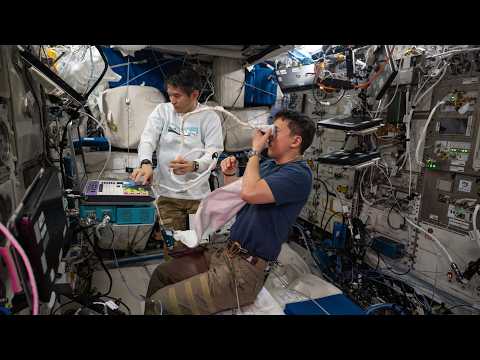
NASA has documented a cluster of changes in long-duration crew members called spaceflight-associated neuro-ocular syndrome (SANS): swelling of the optic disc, flattening of the back of the eyeball, folds in the retina and shifts in vision. NASA considers SANS one of the significant medical risks for extended missions, and MRI studies have also shown changes in brain position, ventricle volume and perivascular spaces after months in orbit.
Why it belongs on a clearance site
Microgravity changes almost every force that moves cerebrospinal fluid: the hydrostatic gradient, venous drainage, sleep quality and the daily rhythm of posture change that Earth-bound bodies take for granted. That makes spaceflight a uniquely informative setting for understanding how the brain’s fluid system responds when its normal operating conditions change. The same understanding could matter for bed-bound patients on Earth, whose fluid dynamics also change with posture.
NeuroClearance is interested in this field as a research context. No spaceflight qualification or demonstrated countermeasure capability is claimed.
Watch
How to read this page
This is general educational background drawn from the sources below. It is not medical advice, and it is not evidence that any NeuroClearance system works. Where a finding comes from animals or from a small human study, the text says so.