
I have watched neurological diseases change the lives of people I care about, and their families. Anyone who has experienced this knows the devastation goes far beyond memory loss or physical symptoms.
A friend lost his wife to early-onset Alzheimer’s. I have seen Parkinson’s affect someone close to my family. And I have spoken with people caring for parents who are gradually losing their independence. It is heartbreaking.
I am currently working on NeuroClearance, a research-stage program developing instrumentation to better understand and measure the brain’s natural maintenance and waste-clearance systems. But while we work on tomorrow’s technologies, I keep coming back to a question: what can we do right now to give ourselves, and the people we love, the best possible chance of maintaining healthy brains as we age?
The encouraging news is that there is quite a lot we can do. A major 2024 Lancet Commission report identified 14 potentially modifiable dementia risk factors and estimated that addressing them could prevent or delay approximately 45 percent of dementia cases at the population level. That is not a guarantee for any individual. But it tells us that brain health is not entirely beyond our influence.
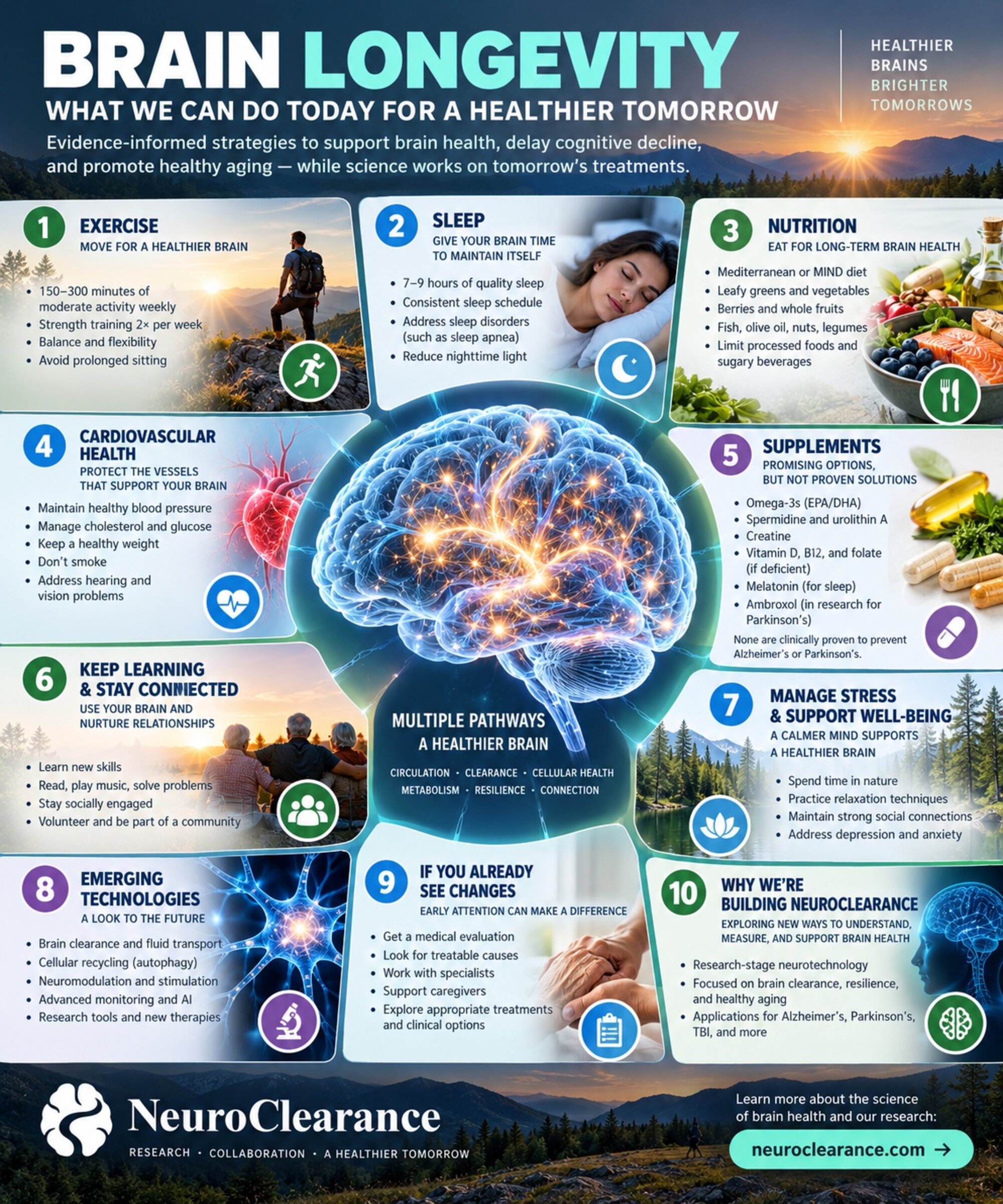
1. Exercise: one of our most powerful tools
If I had to prioritize one intervention for long-term brain and cardiovascular health, regular physical activity would be near the top.
- Aim for approximately 150 to 300 minutes of moderate aerobic activity weekly, as tolerated.
- Add strength training at least twice weekly to preserve muscle, metabolic health and physical independence.
- Include balance, flexibility and coordination training, especially as we age.
- Walk regularly, particularly after meals, and avoid prolonged sedentary periods.
Exercise supports circulation, insulin sensitivity, sleep, mood and cognitive function. It may also influence brain maintenance pathways, although direct glymphatic-clearance benefits in humans remain under investigation.
2. Sleep: give the brain time to maintain itself
Sleep is not simply downtime. Research suggests sleep and brain fluid dynamics are closely connected, potentially affecting how metabolic byproducts are transported.
- Maintain consistent sleep and wake times.
- Seek treatment for sleep apnea and other sleep disorders.
- Reduce nighttime light, noise and other sleep disruptions.
- Avoid relying on alcohol as a sleep aid.
- Get natural daylight exposure, especially in the morning.
We should be careful not to overstate the science: the exact relationship between sleep stages and waste clearance in humans is still being investigated, and the field is actively debating how clearance should be measured at all (see what remains debated). But adequate, restorative sleep is unquestionably important to health.
3. Eat for long-term brain and vascular health
The Mediterranean and MIND dietary patterns are among the most studied approaches to brain-healthy eating. Focus on leafy greens and colorful vegetables; berries and other whole fruits; fish, especially oily fish; extra-virgin olive oil; nuts and seeds; beans and legumes; and whole grains.
Reduce highly processed foods, trans fats, excess sodium and frequent consumption of sugary beverages. The evidence favors an overall healthy dietary pattern, not one miraculous superfood.
4. Protect the blood vessels that support your brain
What is good for your cardiovascular system is often good for your brain. Pay attention to blood pressure, cholesterol, blood glucose, weight, physical fitness and smoking. High blood pressure, diabetes, smoking and elevated LDL cholesterol are among the potentially modifiable risk factors associated with dementia.
Do not overlook hearing loss or untreated vision problems, either. Both deserve attention as part of healthy aging.
5. Supplements: interesting possibilities, not proven solutions
This is where I see a lot of excitement, and a lot of exaggerated claims.
- Omega-3 fatty acids (EPA and DHA). Important nutrients with established biological roles. Eating fish is associated with benefits within healthy dietary patterns, but omega-3 supplements have not been conclusively shown to prevent dementia.
- Creatine. Supports cellular energy metabolism. It has promising research applications, including cognition under certain stressful conditions, but long-term neurodegeneration prevention is unproven.
- Urolithin A. Being investigated for mitochondrial health and mitophagy, the process of recycling damaged mitochondria. Human research is emerging, but clinical neuroprotection remains unproven.
- Spermidine. Studied for autophagy and cellular maintenance. Human cognitive evidence remains limited and inconsistent.
- Vitamin B12, folate and vitamin D. Important when a deficiency is present. Correcting a deficiency can matter greatly, but taking extra vitamins without a deficiency is not an established dementia-prevention strategy.
- Melatonin. May help selected sleep or circadian problems. It is not a proven brain-clearance supplement.
- NAD+ precursors such as NMN and NR. Interesting metabolic research, but no convincing clinical evidence that supplementation prevents Alzheimer’s or Parkinson’s.
My approach is to distinguish biological plausibility from demonstrated benefit. No supplement has been clinically proven to boost glymphatic clearance sufficiently to prevent Alzheimer’s or Parkinson’s disease. And supplements can interact with medications, so more is not necessarily better; talk with your clinician or pharmacist before adding one.
6. Keep learning, connecting and challenging yourself
Our brains respond to how we use them. Learn a language. Play music. Read. Build something. Volunteer. Solve problems. Spend time with people.
Social isolation, depression and low cognitive engagement are important considerations in brain health. The goal is not to complete a daily brain-training app and assume you are protected. It is to maintain a rich, engaged, physically active life.
7. Stress, nature and mental well-being
Chronic stress and poor mental health can affect sleep, cardiovascular health and daily functioning. Spending time outdoors, maintaining friendships, exercising and practicing relaxation techniques may support well-being.
Nature walks, mindfulness and other restorative activities can be valuable, although they are not proven treatments for neurodegenerative disease.
8. Emerging technologies: where the next breakthroughs may come from
Beyond lifestyle and supplements, researchers are investigating:
- Photobiomodulation using red and near-infrared light
- Focused ultrasound and other noninvasive brain technologies
- Electrical and magnetic neuromodulation
- Vagus nerve stimulation
- Advanced sleep and physiological monitoring
- Targeted approaches to cellular protein degradation
- AI-assisted personalized monitoring and intervention research
These technologies are at very different stages of development. Some have established medical uses for specific conditions. Others remain experimental, and none should be assumed to prevent neurodegeneration simply because the mechanism sounds promising.
9. What if someone we love is already experiencing cognitive decline?
This is especially important. Do not assume memory problems are simply normal aging. A medical evaluation may identify treatable contributors such as medication effects, sleep disorders, depression, thyroid disease, vitamin deficiencies or other conditions.
For people with Alzheimer’s disease, specialist care may include symptomatic medications and, in selected early-stage patients, newer amyloid-targeting treatments that can modestly slow progression but carry significant risks. For Parkinson’s, appropriate medications, exercise, rehabilitation and multidisciplinary care can help manage symptoms and preserve quality of life.
Support caregivers, too. They often carry an extraordinary physical, emotional and financial burden.
10. Why we are building NeuroClearance
The brain has sophisticated biological systems involved in fluid transport, cellular recycling, metabolic maintenance and the removal of unwanted proteins. Those systems may change with aging, disease, injury and other physiological stresses.
At NeuroClearance we are exploring a fundamental question: can we develop better ways to understand and measure the brain’s natural maintenance processes, and in time learn whether they can be supported? We are particularly interested in how future research instruments might contribute to work on Alzheimer’s, Parkinson’s, traumatic brain injury, healthy aging and even the unusual physiological challenges of spaceflight.
Our work is early-stage. We have not demonstrated that anything we build prevents or treats these diseases. But I believe these questions deserve serious scientific investigation.
In the meantime, we do not have to wait for a future invention to start making better decisions about brain health. Exercise. Sleep. Eat well. Protect your cardiovascular health. Stay connected. Keep learning. Address medical problems early.
None of these guarantees a disease-free future. Together, however, they offer a practical, evidence-informed foundation for protecting health and independence as we age. The best time to start caring for the brain we hope to have at 80 is decades before we turn 80.
I would like to hear what you are doing to protect your brain health. Write to [email protected]; please keep personal medical details out of email.
How to read this page
This is a personal perspective and general educational background drawn from the sources below. It is not medical advice. Risk-factor estimates describe populations, not individuals. For decisions about exercise, diet, supplements, medications or symptoms, talk with your clinician.
Sources
- Livingston et al., The Lancet, 2024 — Dementia prevention, intervention, and care: 2024 report of the Lancet standing Commission (14 modifiable risk factors; approximately 45 percent of cases potentially preventable or delayed at the population level)
- World Health Organization — Dementia fact sheet
- National Institute on Aging — Assessing risk for Alzheimer’s disease
- Centers for Disease Control and Prevention — Physical activity benefits for older adults